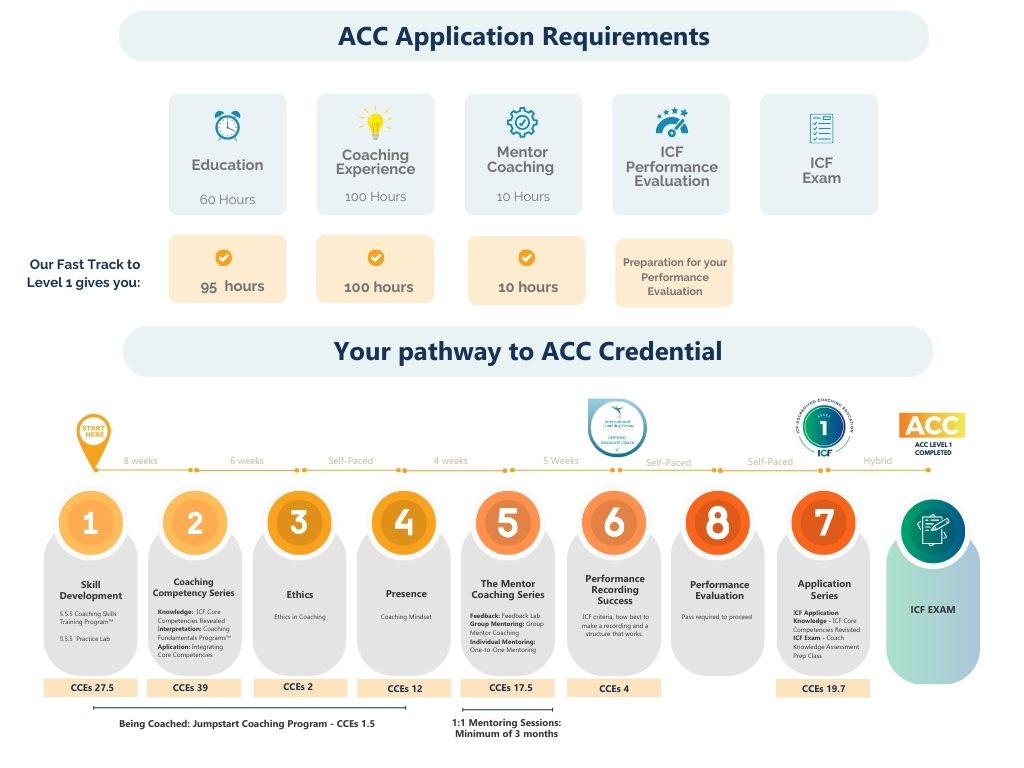
Your Pathway to ACC
We are doing everything we can think of to get you ready to apply for you ACC Credential. We start you off with the Education, you will get your Mentoring from us, even show you how to make your recording and we will pass them through the ICF performance evaluation process for you. Even this course prepares you the ICF Credentialing Exam. Heck, we will even guide your through the application process. in the Credentialling Success Course …. So what is left for you to do?
How about:
- Practice to be the best coach you can be.
- Aggressively pursue getting 100+ hours of coach experience.
- Log your hours.
Complete Quiz #1
The ICF Credentialing Assessment Prep. Class is designed to refresh your knowledge of the ICF Core Competencies AND
help you “think like the ICF” so you may better respond to the questions asked on the formal exam.
This quiz consists of seven questions to explore your general knowledge of the ICF Core Competencies.
A pass score is 100% correct AND you will have an unlimited number of tries to get the answers correct.
Click on “Start Quiz” when you are ready
Core Competencies - Continued
3. Establishes and Maintains Agreements
| Definition: Partners with the client and relevant stakeholders to create clear agreements about the coaching relationship, process, plans and goals. Establishes agreements for the overall coaching engagement as well as those for each coaching session. 1. Explains what coaching is and is not and describes the process to the client and relevant stakeholders. 2. Reaches agreement about what is and is not appropriate in the relationship, what is and is not being offered, and the responsibilities of the client and relevant stakeholders. 3. Reaches agreement about the guidelines and specific parameters of the coaching relationship such as logistics, fees, scheduling, duration, termination, confidentiality and inclusion of others. 4. Partners with the client and relevant stakeholders to establish an overall coaching plan and goals. 5. Partners with the client to determine client-coach compatibility. 6. Partners with the client to identify or reconfirm what they want to accomplish in the session. 7. Partners with the client to define what the client believes they need to address or resolve to achieve what they want to accomplish in the session. 8. Partners with the client to define or reconfirm measures of success for what the client wants to accomplish in the coaching engagement or individual session. 9. Partners with the client to manage the time and focus of the session. 10. Continues coaching in the direction of the client’s desired outcome unless the client indicates otherwise. 11. Partners with the client to end the coaching relationship in a way that honors the experience. |
4. Cultivates Trust and Safety | Definition: Partners with the client to create a safe, supportive environment that allows the client to share freely. Maintains a relationship of mutual respect and trust. 1. Seeks to understand the client within their context which may include their identity, environment, experiences, values and beliefs. 2. Demonstrates respect for the client’s identity, perceptions, style and language and adapts one’s coaching to the client. 3. Acknowledges and respects the client’s unique talents, insights and work in the coaching process. 4. Shows support, empathy and concern for the client. 5. Acknowledges and supports the client’s expression of feelings, perceptions, concerns, beliefs and suggestions. 6. Demonstrates openness and transparency as a way to display vulnerability and build trust with the client. |
5. Maintains Presence | Definition: Is fully conscious and present with the client, employing a style that is open, flexible, grounded and confident. 1. Remains focused, observant, empathetic and responsive to the client. 2. Demonstrates curiosity during the coaching process. 3. Manages one’s emotions to stay present with the client. 4. Demonstrates confidence in working with strong client emotions during the coaching process. 5. Is comfortable working in a space of not knowing. 6. Creates or allows space for silence, pause or reflection. |
C. Communicating Effectively | |
6. Listens Actively | Definition: Focuses on what the client is and is not saying to fully understand what is being communicated in the context of the client systems and to support client self-expression. 1. Considers the client’s context, identity, environment, experiences, values and beliefs to enhance understanding of what the client is communicating. 2. Reflects or summarizes what the client communicated to ensure clarity and understanding. 3. Recognizes and inquires when there is more to what the client is communicating. 4. Notices, acknowledges and explores the client’s emotions, energy shifts, non-verbal cues or other behaviors. 5. Integrates the client’s words, tone of voice and body language to determine the full meaning of what is being communicated. 6. Notices trends in the client’s behaviors and emotions across sessions to discern themes and patterns. |
7. Evokes Awareness | Definition: Facilitates client insight and learning by using tools and techniques such as powerful questioning, silence, metaphor or analogy. 1. Considers client experience when deciding what might be most useful. 2. Challenges the client as a way to evoke awareness or insight. 3. Asks questions about the client, such as their way of thinking, values, needs, wants and beliefs. 4. Asks questions that help the client explore beyond current thinking. 5. Invites the client to share more about their experience in the moment. 6. Notices what is working to enhance client progress. 7. Adjusts the coaching approach in response to the client’s needs. 8. Helps the client identify factors that influence current and future patterns of behavior, thinking or emotion. 9. Invites the client to generate ideas about how they can move forward and what they are willing or able to do. 10. Supports the client in reframing perspectives. 11. Shares observations, insights and feelings, without attachment, that have the potential to create new learning for the client. |
D. Cultivating Learning and Growth | |
8. Facilitating Client Growth
| Definition: Partners with the client to transform learning and insight into action. Promotes client autonomy in the coaching process. 1. Works with the client to integrate new awareness, insight or learning into their worldview and behaviors. 2. Partners with the client to design goals, actions and accountability measures that integrate and expand new learning. 3. Acknowledges and supports client autonomy in the design of goals, actions and methods of accountability. 4. Supports the client in identifying potential results or learning from identified action steps. 5. Invites the client to consider how to move forward, including resources, support and potential barriers. 6. Partners with the client to summarize learning and insight within or between sessions. 7. Celebrates the client’s progress and successes. 8. Partners with the client to close the session. |
Exercise
- Objective: Work with your partner to present in class next week a knowledge-based question you feel might be on the ICF Exam. (original question, not a known sample question)
Generate knowledge-based question from:
- Competency 3 – Establishes and Maintains Agreements
- Competency 4 – Cultivates Trust and Safety
- Competency 5 – Maintains Presence
- Competency 6 – Listens Actively
- Competency 7 – Evokes Awareness
- Competency 8 – Facilitating Client Growth
- General Coach Knowledge
For the next class Present the question and four multiple choice options to select from.
The Student Coach Resources hub is a dedicated space tailored to empower aspiring coaches on their academic and professional journey.
Join our ongoing conversation in Slack by clicking the logo below:

If you need assistance, please contact our Student Service team at support@coachingoutofthebox.com